


Shea Delight

Délice de Karité
Immerse yourself in a world of wellness and pampering with the Délice de Karité line! For a moment of endless comfort, wrap yourself in the delightful caress of shea butter from Burkina Faso—both protective and nourishing. Its fragrance combines with its many benefits to nourish and protect dry skin and long hair.


Type: Shampoo
Délice de Karité Repairing Shampoo (
NOURISHES & REVITALIZES
400ml


Type: Shower Gel
Délice de Karité Melt-in Shower Gel
CLEANSES & SOFTENS
500ml


Type: Care Cream
Délice de Karité Ultra-Repairing Cream
NOURISHES & REPAIRS
200ml


Type: Body & Hair Routines
Délice de Karité Body & Hair Routine + a FREE gift
NOURISHES & REPAIRS
7 products


Type: Conditioner
Délice de Karité Detangling & Repairing Conditioner
NOURISHES & REPAIRS
200ml


Type: Body Lotion
Délice de Karité Moisturizing Body Lotion
MOISTURIZES & NOURISHES
500ml


Type: Hair Mask
Délice de Karité Repairing Hair Mask
NOURISHES & REPAIRS
150ml


Type: Body & Hair Gift Boxes
Délice de Karité Body & Hair Gift Set
MOISTURISES & NOURISHES
Harmony
The Range
Délice de Karité
[img2] for nourished skin and hair [img3]
[img2] for nourished skin and hair [img3]
Our "Délice de Karité" Products for Your Daily Routine
Discover Délice de Karité's body and hair care products

Our "Délice de Karité" Products for Your Daily Routine
Discover Délice de Karité's body and hair care products
Type: Conditioner
Délice de Karité Detangling & Repairing Conditioner
NOURISHES & REPAIRS
200ml


Type: Body Scrub
Délice de Karité Moisturizing Body Scrub
EXFOLIATES & MOISTURIZES
150ml
Type: Hair Mask
Délice de Karité Repairing Hair Mask
NOURISHES & REPAIRS
150ml


Type: Hand Cream
Shea Butter Delight Moisturizing Hand Cream
MOISTURIZES & PROTECTS
150ml
We want to create "Made in France" products that are affordable and feature natural and vegan ingredients.

Customer Reviews

“A very pleasant product—my skin feels soft and moisturized.”

“I love this body lotion—it smells great, absorbs quickly, and isn't sticky.”

“This shampoo is great—it has a delicious scent and moisturizes really well.”
Discover our products for your daily routine

Délice de Karité Body Ritual
- Made In France
- Dermatologically tested

Délice de Karité Body & Hair Routine + a FREE gift
Escape to a world of well-being and let yourself be wrapped in the softness of Shea Butter. This must-have for dry skin is a true everyday treatment suitable for the whole family. Moisturising and nourishing, it also repairs the most delicate hair and spreads a comforting scent.
- Shea Butter from Burkina Faso
- Vegan
- Dermatologically tested
- Made in France

Délice de Karité Hair Ritual
- Made In France
- Dermatologically tested

Délice de Karité Body Pouch
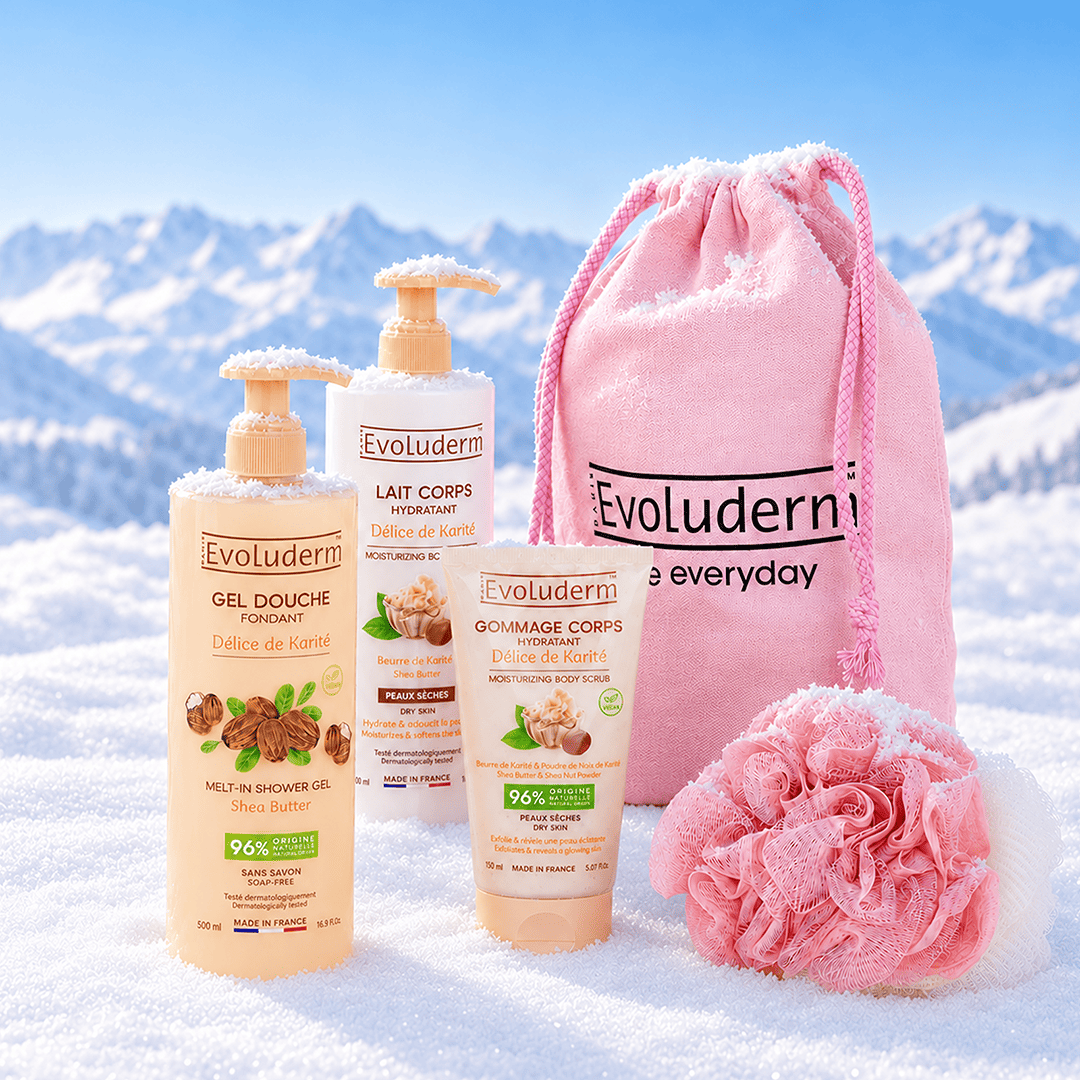
Looking for the perfect gift? Look no further! The Délice de Karité Body Pouch is the ideal gift. Treat yourself to a cocooning moment with the Moisturising Body Scrub, the Melting Shower Gel and the Moisturising Body Milk, enriched with Shea Butter.
- Ingredients of natural origin
- Vegan
- Dermatologically tested
- Made in France*
*Excluding pouch
Similar articles

SOS dry skin
SOS dry skin: protecting your skin during winter Winter often rhymes with magical moments, snowy landscapes and cozy evenings, but for many, it brings its share of drawbacks. Freezing temperatures, piercing winds, and indoor heating can make our skin very dry, sensitive, and sore. At Evoluderm, we understand these issues and offer you effective solutions to take care of your skin during this season! Discover our tips specially designed to bring you comfort and maximum hydration during winter! ❄️ Understanding your skin's needs To take good care of your skin in winter, it is essential to understand its structure and specific needs. The skin is made up of three distinct layers, each with a specific role: 1. The epidermis: we can see it, touch it, it is the outermost layer of the skin. The epidermis protects us from external aggressions such as bacteria, pollutants and UV rays. Skincare products applied to the skin's surface, such as moisturizers, help strengthen this barrier by retaining moisture and protecting the skin from environmental factors. In winter, the cold outside and indoor heating reduce air humidity, which can dry out the skin. This leads to feelings of tightness, itching, and rough skin. 2. The dermis: The dermis is located under the epidermis and is composed of collagen, elastin , and reticular fibers, which give the skin its strength and elasticity. In winter, the cold can cause a decrease in sebum production, which affects the dermis's ability to maintain adequate hydration, making the skin drier and less supple. 3. The hypodermis: The deepest layer, it plays an important role in protecting organs from heat. Although this layer is less directly affected by climatic conditions, its condition influences the overall well-being and comfort of the skin. How to take good care of your skin in winter? The skin has a complex and delicate structure, where each layer plays an essential role in maintaining its balance and health. In winter, weather conditions can disrupt this balance and affect the skin in different ways. To protect your skin during this season, it is crucial to adopt a skincare routine adapted to the climatic challenges. A WORD FROM THE EXPERT: Taking care of your skin in winter is essential to avoid dehydration, irritation and other skin problems. Here are five tips for maintaining healthy skin during this cold season: Intense hydration: The cold, dry air of winter can quickly dehydrate skin. Use a rich, thick moisturizer to strengthen the skin barrier. Use a humidifier: Indoors, heated air is often dry and can worsen skin dehydration. Use a humidifier to add moisture to the air, especially in rooms where you spend a lot of time, such as the bedroom. Avoid hot showers and baths: While a hot shower can be comforting in winter, hot water can strip your skin of its natural oils, making it drier. Opt for lukewarm water and limit your shower time to about 10 minutes. Sun protection: Even in winter, UV rays can damage your skin, especially if you're involved in outdoor activities like skiing. Apply sunscreen with an SPF of at least 30 (or a moisturizer with an SPF) to all exposed areas of your body, including your face, hands, and lips. Adapt your skincare routine: In winter, your skin has different needs. Reduce the use of products containing drying ingredients like retinoids and exfoliating acids. Opt for a gentle cleanser that doesn't strip the skin of its natural oils, and incorporate a hydrating serum into your routine. Jennyfer Aiach Brami, Doctor of Pharmacy Use products that are appropriate for the season External factors have a strong impact on the health of our skin. Indeed, seasonal variations influence how your skin reacts, and it is therefore important to adapt your beauty routine to each season! During the cold months, choose products formulated with moisturizing and nourishing ingredients: Aloe Vera: Known for its moisturizing and soothing properties, it helps maintain hydration while soothing irritation. 100% Aloe Vera Routine Rediscover hydrated and plumped skin with our 100% Aloe Vera Hydration Routine. Made up of 6 treatments, this face & body routine is ideal for hydrating and soothing your skin while giving it a feeling of freshness every day. I DISCOVER! Hyaluronic Acid: It retains water in the skin, strengthening the hypodermis and preventing dehydration. At Evoluderm, you can find many products composed of Hyaluronic Acid, including all our Serums ! Detox Serum A true anti-pollution abacus, it is enriched with antioxidant Marine Algae which protect the epidermis from external aggressions and with hydrating Hyaluronic Acid to plump and unify the skin texture. Its light, non-sticky texture allows the skin to breathe again! I WANT IT! Oils (argan, sweet almond): rich in fatty acids and Vitamin E, they strengthen the skin barrier and provide antioxidant protection. Sweet Almond Oil Formulated with 99.8% natural ingredients, the Soothing Beauty Oil with Sweet Almond Oil protects and softens. Enriched with Vitamin E, it soothes the skin and eliminates feelings of tightness. Ideal for repairing and nourishing hair. I DISCOVER! Moisturize your skin more Finally, to prevent chapping, dryness and irritation caused by the cold, our last tip is to adopt a complete and appropriate skincare routine. Use a cleansing oil . These are perfect for dissolving impurities while leaving a nourishing protective film. Exfoliate : Exfoliating your skin once or twice a week helps remove dead skin cells and improve the penetration of moisturizers. Use moisturizer daily. Hyaluronic Acid, the star ingredient for dehydrated skin! KNOW EVERYTHING!
Read the article
How to boost hair growth?
How to boost hair growth? Growing your hair can sometimes seem like an impossible mission, especially when patience isn't one of your strengths (oops...)! The good news is that there are natural and accessible solutions to stimulate hair growth, strengthen hair lengths, and prevent breakage. From simple daily actions to targeted treatments and a suitable diet, discover in this article everything you need to know to help your hair grow faster and healthier. Understanding the Hair Growth Cycle Why am I losing so much hair every day? How long does a hair last? You've probably already asked yourself these existential questions... Whether you have straight, curly, frizzy, dry, or oily hair, it develops in the same way. The hair cycle is divided into three phases: anagen, catagen, and telogen. Anagen phase: hair growth The anagen phase is the period of active hair growth. It lasts approximately 3 years in men and up to 5 years in women. During this period, the hair bulb is very active: it produces keratin, allowing the hair to form and grow. Catagen phase: hair regression This relatively short phase (2 to 3 weeks) marks the transition between hair growth and rest. The hair follicle shrinks and becomes inactive. The connection between the hair bulb and its nutrient base is broken. At this stage, the hair no longer grows, but remains attached to the scalp for a certain time. Telogen phase : hair resting Before falling out, the hair enters a resting phase that lasts approximately 2 to 3 months. During this time, the hair remains lodged in the scalp but is no longer nourished. It eventually falls out, usually pushed out by a new hair that is beginning to grow. As long as the hair has not exhausted its number of natural cycles (around 25), it can fall out and then grow back again. Causes that slow hair growth Before looking for solutions to speed up hair growth, it's important to understand what can slow it down. Sometimes, it's not the hair that's growing slowly, but rather internal or external factors that are preventing it from reaching its full potential. Here are some common causes to consider: An unbalanced diet Hair needs vitamins, minerals, and proteins to grow. Deficiencies in biotin, iron, zinc, or B vitamins can weaken follicles and slow hair growth, or even cause excessive hair loss. If you're interested in this section, skip to the end of this article! Stress and fatigue Chronic stress or prolonged lack of sleep can disrupt the hair cycle by causing it to transition prematurely into the telogen phase. As a result, hair stops growing or falls out more easily. Overly aggressive hair care Harsh shampoos, excessive heat from hair dryers and straighteners, frequent coloring, or tight hairstyles weaken the hair fiber. This leads to breakage, which makes the hair appear to be stunted, even though it actually breaks before reaching a good length. Our tips for growing hair faster Hair care to favor Here are the hair products you should prioritize: Stimulating vegetable oils Of all the vegetable oils available, castor oil remains the best for promoting hair growth. It's very thick and can be mixed with coconut oil for easier application. Once a week, massage this mixture into your scalp and leave it on for at least 30 minutes. Then, shampoo and rinse thoroughly. I WANT HER I BUY Gentle silicone-free shampoos Silicones are synthetic ingredients that leave a film on your scalp, which in the long run prevents your hair from receiving the nutrients it needs for growth. Therefore, choose shampoos with gentle, silicone-free formulas rich in natural-origin active ingredients that cleanse without stripping and that will help your hair grow faster in the long run. I'M CRACKED UP I DISCOVER Daily actions to adopt Here are some simple but effective steps for rapid hair growth: Massage the scalp regularly It is recommended to massage your scalp for 3 to 5 minutes every time you shampoo your hair. This stimulates microcirculation, which promotes nutrient delivery to the hair follicles. You can do this with your fingertips, head down, or using a silicone massage brush. Space out washes Washing your hair too often can dry out the scalp or stimulate excessive sebum production. We recommend washing your hair 2 to 3 times a week at most with a gentle, suitable shampoo . You can also alternate with a purifying dry shampoo, which will help absorb excess sebum. I WANT IT 💡Tip: If you exercise regularly, or even daily, you don't need to wash your hair every time. A simple rinse with clean water is often enough to remove sweat and impurities, without damaging the scalp! Leave your hair down as often as possible Overly tight hairstyles weaken the roots. We recommend opting for gentle ties using metal-free elastics and satin or silk scrunchies to prevent breakage due to friction. Sleeping on a satin or silk pillowcase This type of material reduces friction during the night, which limits breakage and preserves the hair's natural moisture. SOS pollinated hair: our tips for purified hair READ THE ARTICLE
Read the article
First rays of sunshine: how to prepare your skin?
How to prepare your skin before going in the sun? With the arrival of spring, temperatures rise and the first rays of sunshine appear. After a long winter, wrapped up in ten layers of sweaters, our skin needs special attention to gradually readjust to sun exposure. In this article, discover our tips for preparing your skin for the sun and thus giving you a luminous, long-lasting and, above all, safe tan! Why prepare your skin before your first exposure to the sun? After hibernating all winter, our skin really needs to be prepared for the sun. It's thinner, drier, more sensitive, and therefore much more vulnerable to the first rays. (No, no, it's not just a sunburn!) Two types of ultraviolet rays are involved: UVA rays penetrate deep into the dermis , causing premature aging of the skin (wrinkles, loss of firmness) and promoting pigment spots. UVB rays remain on the surface, but are responsible for sunburn and can damage epidermal cells. This is why preparing your skin for the sun from March is a smart and safe beauty tip that allows you to: Strengthen the skin barrier Promote a more even and longer-lasting tan Limit the risk of brown spots Prevent the signs of skin aging The key steps to preparing your skin for the sun Gently cleanse and exfoliate your skin Exfoliation is an essential step to remove dead skin cells and refine skin texture. This allows for better absorption of skincare products and a more even and lasting tan. For your face, we recommend using a gentle scrub , suited to your skin type, such as our Healthy Glow Carrot Scrub , once or twice a week. For the body, the grains are generally larger, opt for the Exhilarating Monoi Body Scrub using circular movements once a week. Intensely moisturize with suitable care Well-hydrated skin is more resilient skin. The key to preparing your skin for the sun is to choose a moisturizer rich in nourishing agents such as Hyaluronic Acid , Shea Butter or Aloe Vera . Our Aloe Vera Moisturizing Day Cream is ideal for this preparation phase. For the body, we recommend the Shea Butter Moisturizing Body Lotion . Adopt a diet rich in antioxidants 💡Did you know? Antioxidants are substances that help preserve cells by protecting them from oxidative stress caused by free radicals. Free radicals are unstable molecules capable of damaging cells and their DNA, which can promote premature aging. Prepare your skin for the sun by eating a diet rich in antioxidants, many foods are rich in them: - Fruits include grapes, which are rich in resveratrol, apples, which are a source of flavonoids, and pomegranates, which contain ellagitannins and anthocyanins. - Berries and red fruits (strawberries, raspberries, and blueberries) are very rich in antioxidants such as anthocyanins, ellagic acid, quercetin, and resveratrol. - Vegetables (broccoli, spinach, artichoke, carrots, etc.) which contain many antioxidant substances such as beta-carotene. - Dried fruits such as prunes, goji berries or cranberries. - Oilseeds (hazelnuts, walnuts, almonds, etc.) with their high vitamin E and polyphenol content. - Spices with their many anti-inflammatory benefits: turmeric, ginger, cloves, etc. - Herbs such as thyme or garlic which contain allicin. - Raw cacao which is rich in polyphenols and an excellent source of zinc, copper, magnesium and potassium. 💡Tip: To avoid sunburn in spring, gradually expose yourself for a maximum of 15 to 20 minutes per day. Use sunscreen daily Contrary to popular belief, sunscreen isn't just for the beach ! An SPF30 or SPF50 facial sunscreen is recommended starting in spring, even under overcast skies. It protects the skin and acts as a UV barrier, preventing the appearance of the first spots. Pre-sun carrot juice recipe rich in beta-carotene To naturally prepare your skin for the sun, it's important to combine external care with internal well-being. To do this, we're sharing a carrot juice recipe you can enjoy without moderation! Rich in beta-carotene, carrot juice is a powerful ally for cell regeneration. It helps protect the skin from the effects of the sun , visibly improves its quality, and helps fight acne. It also promotes good hydration, thus providing a luminous complexion. Turmeric reinforces the benefits of carrots : it brightens the complexion, deeply hydrates, fights imperfections, protects against external aggressions, slows down skin aging and acts as a powerful natural anti-inflammatory. CARROT JUICE BEFORE SUN 🥕 You will need: 10 carrots, 3 oranges, 1 lemon, a piece of turmeric and a juice extractor. How to make it? Wash the carrots, then cut them in half. Peel the oranges and lemon, then cut the piece of turmeric. Start juicing by inserting half of the carrots, then add the citrus and turmeric, and finish with the remaining carrots to facilitate the passage of the softer ingredients. Serve chilled… and enjoy! Now that your skin is ready to face the sun, all you have to do is get your legs out and enjoy summer in peace! 4 tips for maintaining your tan while on vacation READ THE ARTICLE
Read the article